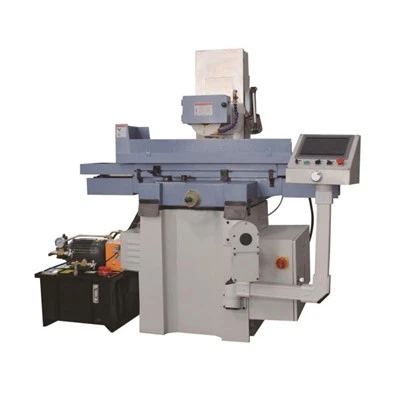
If you’ve ever walked the floor of a metal fabrication shop or a precision machining facility, chances are you’ve spotted automatic surface grinders at work, humming steadily to flatten, smooth, and finish flat workpieces like steel plates, aluminum blocks, or cast iron parts. For years, these machines were pigeonholed as “flat surface only” tools—built with a reciprocating table to feed parts under a rotating abrasive wheel, a spindle that moves vertically, and an electromagnetic chuck to hold workpieces rigid. But over the last decade, I’ve fielded a question from shop owners and machining operators so consistently, it’s earned a spot in my weekly Q&A: “Can an automatic surface grinder be used for internal grinding?” Automatic Surface Grinder
As an automatic surface grinder supplier, I’ve tested hundreds of custom setups, worked with precision machining teams to troubleshoot, and even seen internal grinding operations transform from makeshift hacks to standard, reliable processes using equipment originally designed for surface finishing. The short answer? Yes, it can—when you adjust the right components, account for key process variables, and avoid common pitfalls that trip up first-time users. In this post, I’ll break down how internal grinding differs from the surface work these machines are known for, what customizations make it possible, and why more shops are leaning into this dual-use setup to cut costs and streamline their workflows.
First, let’s get clear on the basics: surface grinding vs. internal grinding, and why the original setup of an automatic surface grinder works for one and not the other. A standard horizontal-spindle surface grinder (the most common type for precision work) uses a large, flat abrasive wheel mounted on a spindle that spins parallel to the work table. The goal is to remove material evenly across a flat surface, whether that’s to get a part to a tight thickness tolerance or create a smooth, flat finish. Internal grinding, by contrast, is the process of finishing the inside of a bore—whether that’s a small hole in a hydraulic valve, a bearing race, or a gear housing. Here, you’re working with a concave, curved surface, not a flat one, and the tool you use is a much smaller grinding wheel that spins at extremely high speeds to remove material without warping the thin walls of the bore.
For decades, shops relied on dedicated internal grinders—machines built from the ground up for this exact task. These tools have spindles designed for high rotational speeds, way higher than the typical surface grinder’s spindle, and worktables that hold workpieces securely while the spindle feeds into the bore. But here’s where the surface grinder’s unsung flexibility comes in: automatic surface grinders have precise, repeatable linear axes (X, Y, and Z) that can be programmed to move with micron-level accuracy, something many older or entry-level dedicated internal grinders don’t offer. That same precision that lets a surface grinder move a 12-inch steel block back and forth with ±0.001mm accuracy can be repurposed to move a small internal grinding wheel into a bore just as reliably.
The key is modifying a few core components, not replacing the entire machine. The first and most critical upgrade is the spindle. Standard surface grinder spindles are built to handle large, heavy flat wheels, usually with maximum speeds of 1,500 to 3,000 RPM—far too slow for internal grinding, which requires wheel speeds of 10,000 RPM or higher, and often up to 50,000 RPM for small bore diameters (smaller wheels need higher speeds to achieve the correct surface speed for material removal). For our customers looking to add internal grinding capabilities to their existing automatic surface grinder, we often recommend a high-speed spindle retrofit. These spindles are compact, mount to the surface grinder’s existing quill (the part that moves vertically to feed the wheel down), and are powered by either high-frequency electric motors or air spindles for ultra-precise, low-vibration operation.
Next, you’ll need to adjust the workholding setup. On a standard surface grinder, workpieces are held flat by an electromagnetic chuck, which is perfect for flat parts. For internal grinding, you need to hold the workpiece so the bore is aligned perfectly with the grinding wheel’s axis—any misalignment, even a few thousandths of a millimeter, will cause uneven material removal or a out-of-round bore. There are a few workholding options here: a precision vise that clamps the workpiece at a 90-degree angle, a collet fixture that grips the part’s outer diameter, or even a custom rotary table that indexes the workpiece so multiple bores can be ground without re-fixturing. I’ve worked with a team that manufactures hydraulic pumps, for example, who repurposed their 12-inch automatic surface grinder by adding a 4th-axis rotary table; now they can grind 8 bores per part in one setup, cutting their fixture change time by 70%.
Then there’s the grinding wheel itself. Internal grinding wheels are much smaller than surface grinding wheels—usually 1 inch in diameter or less, depending on the bore size. They also have a different bond structure, designed to handle the high speeds and the curved surface finish. Surface grinding wheels use a harder bond to handle the heavy material removal from flat surfaces, but internal grinding wheels need a softer bond that self-dresses as it cuts, so it doesn’t get clogged with fine swarf from the bore. One mistake I see new users make is trying to use a standard surface grinding wheel for internal work; this causes excessive vibration, uneven wear, and a poor surface finish. We always advise customers to pair their retrofit spindle with a vitrified or resin-bonded diamond or CBN (cubic boron nitride) wheel, depending on the workpiece material—CBN works great for steel, while diamond is ideal for cast iron or ceramics.
Of course, there are limits to what an automatic surface grinder can do for internal grinding, and it’s important to set realistic expectations before making the switch. For one, the maximum bore diameter you can grind is limited by the spindle’s reach and the size of the worktable. On a standard 16-inch automatic surface grinder, you can typically grind bores up to 6 inches in diameter, but for larger bores, a dedicated internal grinder is still the better bet. You also can’t achieve the same material removal rate as a dedicated internal grinder, because the surface grinder’s original spindle isn’t built for the high torque needed for heavy cuts in small bores. For high-volume production runs with large batch sizes, a dedicated machine will still be more cost-effective per part, but for low-to-medium volume runs, prototype work, or shops that already have an automatic surface grinder on hand, the dual-use setup is a game-changer.
I’ve seen firsthand how this setup transforms small to mid-sized shops. Last year, a job shop in Ohio that does work for the automotive industry reached out to me; they had a 10-year-old automatic surface grinder that they used for finishing valve bodies and pistons, but they were outsourcing their internal bore grinding to a tool and die shop for $120 per part. We worked with their team to install a high-speed air spindle, add a precision collet fixture, and train their operators on the new setup. Within three months, they were grinding their own internal bores for $25 per part, cutting their production costs by nearly 80% and reducing lead times by two weeks. That’s the kind of return on investment that makes a lot of shop owners take a second look at their existing equipment, instead of shelling out $50,000 or more for a dedicated internal grinder.
There are also a few best practices to keep in mind to make the setup successful. First, invest in good coolant delivery. Internal grinding generates a lot of heat, and that heat can cause the workpiece to expand, leading to dimensional errors. A high-pressure coolant system that delivers fluid directly to the grinding wheel-workpiece interface is non-negotiable—it flushes out swarf, cools the part, and prevents wheel clogging. Second, program for slow feed rates. Because you’re working with a small wheel and a thin bore, feeding too fast can cause chatter or wheel breakage. Most automatic surface grinders have CNC controls that let you program feed rates as low as 0.001 mm per pass, which is perfect for fine internal grinding work. Third, schedule regular wheel dressing. Unlike a surface grinder, where the wheel is dressed once every few hours, internal grinding wheels need to be dressed before every use to maintain their shape and sharpness. Many modern surface grinders with CNC controls have automatic dressing attachments that simplify this process, so operators don’t have to stop production to dress the wheel manually.
One common misconception I hear is that internal grinding on a surface grinder is only good for roughing work— but that’s not true. With the right setup, you can achieve surface finishes as smooth as Ra 0.4 µm, which is comparable to what you’d get from a dedicated precision internal grinder. We recently worked with a medical device manufacturer that needed to grind 0.5 mm diameter bores in titanium for surgical implants; their automatic surface grinder setup delivered consistent bore diameters within ±0.002 mm, and a surface finish that met FDA requirements. The key here was using a high-precision linear scale on the machine and a low-vibration air spindle, which eliminated the small amounts of play that can show up in less precise surface grinder setups.
Of course, this setup isn’t for every shop. If you’re running high-volume production of large internal bores, or if your shop doesn’t have operators trained to adjust CNC programs and retrofit components, a dedicated internal grinder is still the better choice. But for shops that already have an automatic surface grinder, are looking to expand their capabilities without a large capital investment, or need flexibility to switch between surface and internal work for different jobs, the dual-use setup is a viable, cost-effective option.
As an automatic surface grinder supplier, our job isn’t just to sell machines—it’s to help our customers get the most out of their equipment. That means being honest about what a surface grinder can do, even when it’s outside the original scope. The question “Can an automatic surface grinder be used for internal grinding?” isn’t a yes-or-no question—it’s a question about customization, adaptation, and knowing how to leverage the precision and flexibility of your existing equipment. For many shops, the answer is a resounding yes, and the payoff in reduced costs and faster lead times is hard to ignore.

If you’re considering adding internal grinding capabilities to your automatic surface grinder, or you have questions about retrofit options, custom setups, or process training, we’d encourage you to reach out to our team for a no-obligation consultation to discuss your needs, capabilities, and next steps.
Hydraulic Surface Grinder References
- “Precision Surface Grinding: Principles and Applications,” Industrial Press, 2019.
- “Internal Grinding Technology: Advances in Spindle Design and Workholding,” Journal of Machining Science and Technology, Vol. 24, No. 3, 2020.
- Retrofit Guide for Automatic Surface Grinders, Association for Manufacturing Technology (AMT), 2021.
- “Diamond and CBN Wheels for Precision Grinding,” Gear Technology Magazine, Vol. 38, No. 6, 2018.
Wuxi Mingxu Machinery Equipment Co., Ltd.
As one of the most professional automatic surface grinder manufacturers and suppliers in China, we’re featured by quality products and good price. Please rest assured to buy the best automatic surface grinder for sale here from our factory. Also, custom service is available.
Address: No. 5-5 Jinke Wealth Plaza, Changjiang North Road, Xinwu District, Wuxi City, Jiangsu Province
E-mail: yingyingmxjd@163.com
WebSite: https://www.mingxu-china.com/
